How to increase monthly active users: MAU growth strategies, benchmarks 2025 & real app examples

Elena Montoya
Want to grow your app’s user base and keep them active every month? In this guide, you’ll discover actionable strategies to increase MAU, learn how to calculate it, and benchmark your results by industry and platform. Use these data-backed MAU growth strategies to strengthen your user engagement and retention strategy and improve your overall monthly active users growth.
What is MAU? Monthly active users definition
Monthly active users (MAU) is the number of unique users who opened or interacted with your app at least once within a 30-day period. It is one of the core metrics used to measure user engagement and overall product health.
However, this number does not indicate whether they are new or returning customers, nor does it specify how active they were.You can track MAU on your app through unique identifiers, such as usernames, email addresses, phone numbers, or other forms of authentication.
Why is MAU important for apps?
MAU is a crucial metric for gauging your app’s success and understanding its growth rate, if any.
If you are unaware of how many people use your app and what factors affect those numbers, it will be hard for you to make informed decisions about where to best focus development and marketing resources.
Witnessing steady increases in your MAU over the months means your business is taking a larger market share, which can impress investors and help you secure funding.
Furthermore, MAU, combined with other qualifying metrics, can be a valuable tool for benchmarking against your competitors. In many cases, your MAU metrics will also determine the prices you pay for marketing tech tools that will help you further improve your app’s performance.
What’s the difference between MAU and DAU?
MAU counts users who are active over a 30-day period, while DAU counts daily active users.
How to measure MAU: formula to calculate MAU & analytics tools to track it
Since MAU is the total number of monthly active users in a given month, the formula is very simple:

How the number of MAU is calculated in Pushwoosh
By the past month, a tool you use to track MAU can mean a period of time between the first and the last day of any given month (so, for example, it will be 1–28 or 1–29 in February and 1–31 in July).
Alternatively, a tool may track MAU for the period between the same dates of consecutive months, for example, between July 15 and August 15.
In Pushwoosh, both options are available on the Statistics dashboard.
To answer another question you have: what tools can you use to calculate MAU? — the short answer will be: you can track your number of MAU in Pushwoosh.
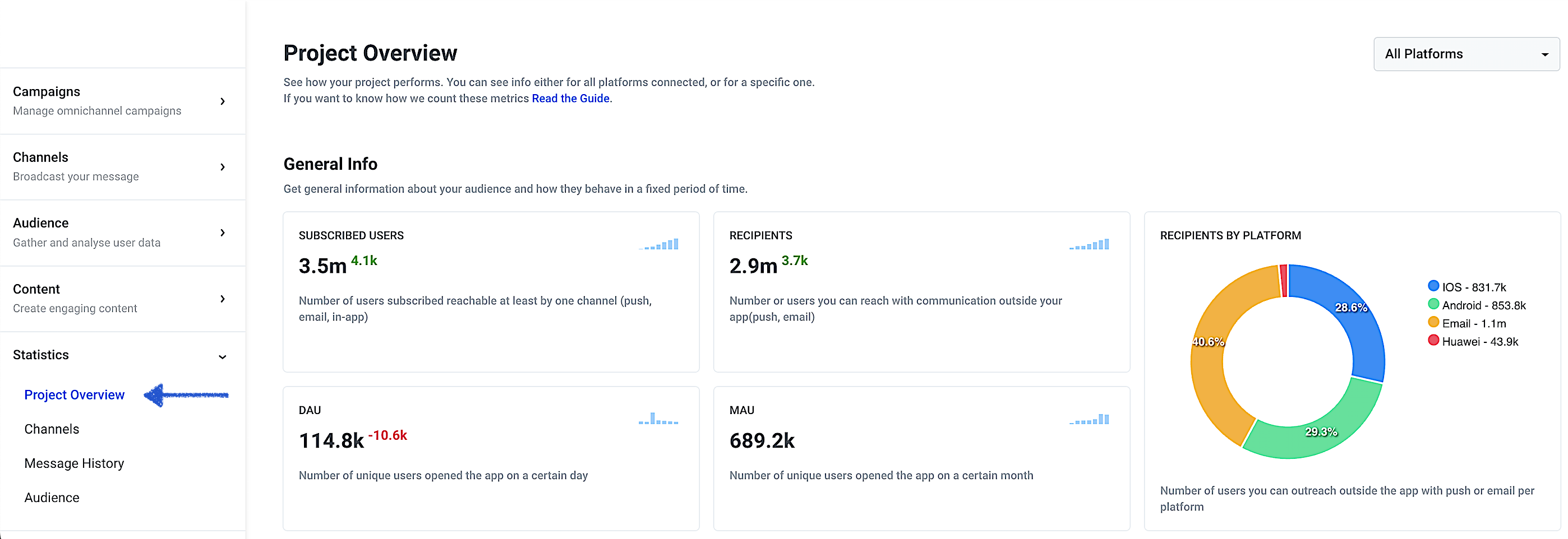
📈Learn what other app performance metrics you can monitor in Pushwoosh
What factors impact MAU growth?
Naturally, MAU is shaped by multiple factors: app vertical, Naturally, MAU is shaped by multiple factors: app vertical, use-case frequency, and how consistently the product delivers value. A monthly activity rate of under 20% might be expected in seasonal or utility-driven apps, whereas high-performing social, finance, or gaming apps often exceed the average, especially when powered by strategic user communication.
So, what’s a strong MAU rate for your app? As always, context is key. Jump to the benchmark section to explore MAU rates by industry.
The tricky part about tracking MAU
While MAU can be useful for measuring your app’s success and identifying opportunities to optimize marketing efforts, there are some things you should watch out for. If taken out of context, it can potentially skew your understanding of your app’s performance and lead you to false conclusions that can be detrimental to your marketing efforts.
If you base your decision solely on your monthly active users, you can never confidently say that the number of users is growing organically or if users are coming to your app because they enjoy it. For example, imagine a user downloading your app after seeing an engaging ad, then deleting it soon after because the expectations that led them to install the app were not met. Situations like this can cause your MAU numbers to spike if you attract lots of traffic through advertising, but drop rapidly after your ad campaigns come to an end.
As it turns out, MAU metric doesn’t necessarily prove you’re attracting a relevant audience or doing a good job of retaining them.
Nevertheless, there are app categories that should track MAU
Media apps should pay close attention to their MAU since the percentage of users opening their apps is crucial to their business. This is because the more people flood into your app, the greater the potential for advertising revenue. So if you’re a media company or any other kind of app that relies heavily on ad revenue, MAU is a metric worth tracking.
For all other app types, tracking MAU is beneficial but should never be used as a key performance indicator (KPI) for business effectiveness or app health.
Metrics to track in addition to tracking MAU
Sometimes, MAU just doesn’t cut it, and you might need help from other metrics to see the whole story. Here are some additional metrics that can help you better understand MAU and measure success for your app:
Stickiness rate
The stickiness of your app is a clear indicator of how valuable it is to users. A high stickiness rate can indicate that users come to rely on or love your app so much that they use it daily. Key features usually present in sticky apps are a loyal following, low user churn, and high engagement levels. This can be seen in a movie-streaming application or a gaming platform where users are highly engaged and use the application regularly.
By measuring stickiness rate combined with MAU, you can begin to understand how valuable your app is and which features are driving user engagement.
New vs. returning users ratio
Tracking the percentage of new users against the percentage of returning users in your app can help you analyze and bring to light audience behavior and engagement levels. Striking the right balance depends heavily on the industry and the goals of your app. For example, if you’re still in your growth stage and looking to get your app seen by as many people as possible, you might focus on engaging new customers. At the same time, returning customers will be the driving force behind your app’s growth, especially if you have a loyal user base who loves your product.
Referral metrics
Referral metrics have to do with how well your users are referring to your app and can give you insight into the organic growth of your business.
In app marketing, word of mouth and referrals are as effective as in any other domain. You can see the leading apps rely on the power of referrals:
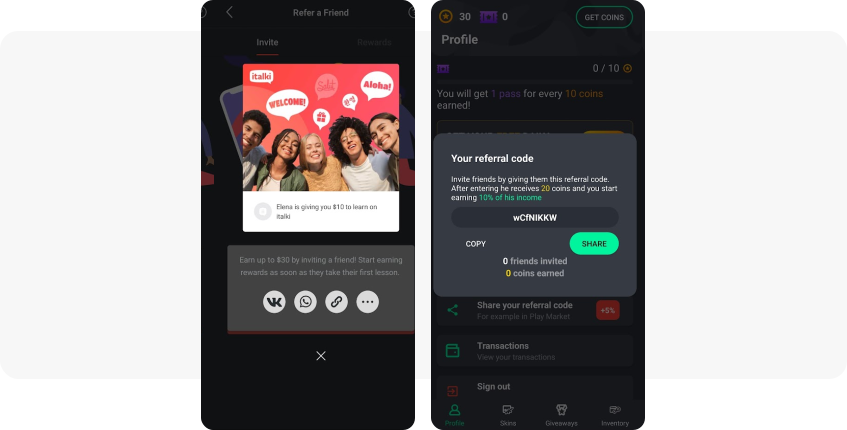
Examples: Referrals work for Italki, a language-learning platform, and GC.SKINS, a game app
By tracking referral metrics, you can get an idea of how your users are spreading the word about your app and whether these actions are resulting in real conversions.
Retention rate
App retention rate is the number of users who continue using an app over a period of time, expressed as a percentage. Retention rate is a key metric in mobile app marketing that can tell you how well your app is performing and how likely users are to stay with the product. A low retention rate indicates a problem with either user experience, branding, or both.
🤝Benchmark your user retention rates against industry medians — access exclusive 2025 data
MAU benchmarks [2025]: What is a good MAU rate for mobile apps?
According to the Pushwoosh Benchmarks Study 2025, the average monthly active users (MAU) rate on iOS is 18.99%, while Android apps see a higher average of 34.27%.
It’s important to remember that not all apps are built for the same audience or purpose. Therefore, benchmarks are bound to differ for monthly active users depending on what industry you’re in and whether you’re an iOS or Android developer.
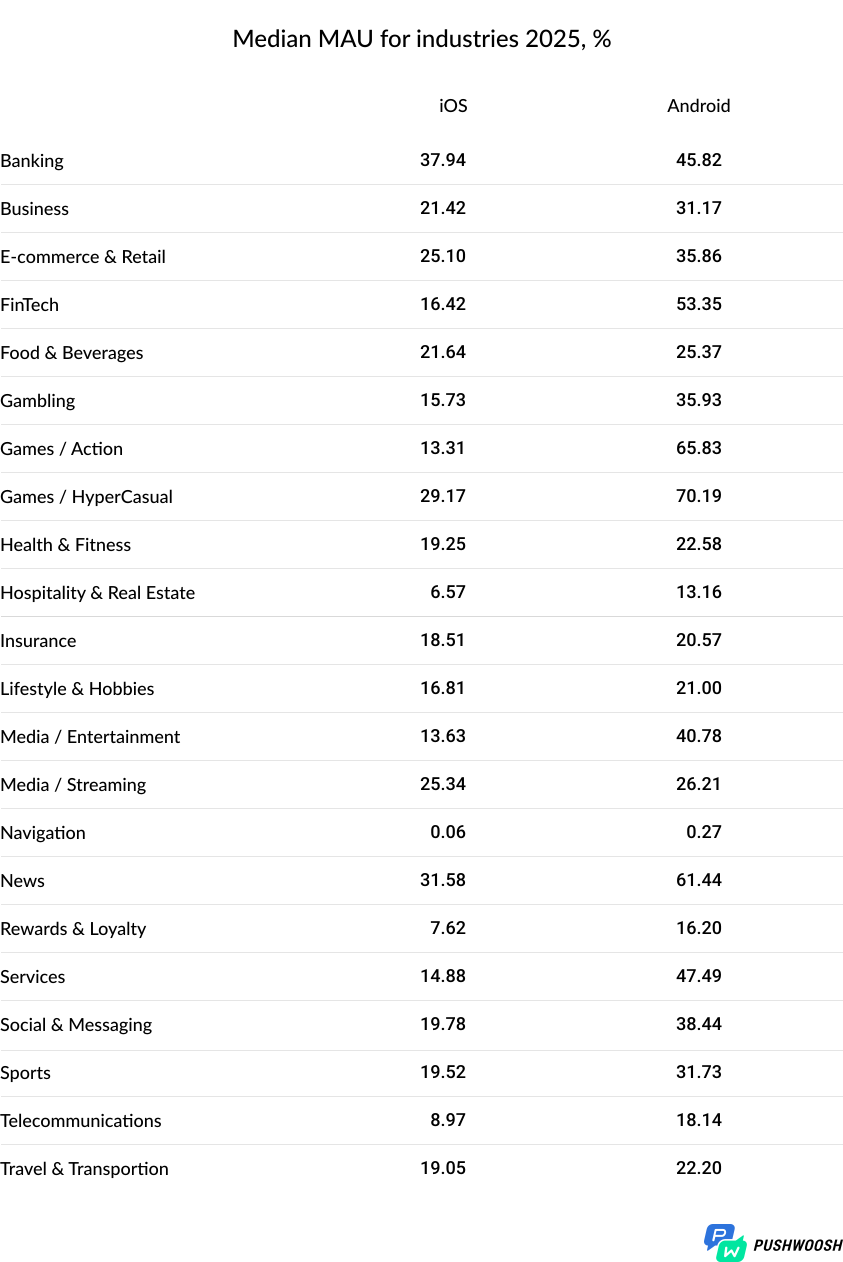
Platform insights
For most industries, Android shows a higher MAU than iOS, with the largest gap in Fintech, Games (both hypercasual and action), and News. Only the streaming industry shows comparable MAU on both platforms.
Industry insights
The lowest MAU is seen in Navigation, Hospitality, and Rewards & Loyalty, all on iOS. The highest MAU is in Banking, Fintech, Games, and Services on Android.
Best strategies to increase MAU
To increase monthly active users (MAU), apps need to combine value-driven onboarding, effective push notification opt-ins, habitual engagement loops, and personalized omnichannel messaging.
If you’ve consistently seen little growth in your MAU, then it’s time to get back to the drawing board and re-evaluate your strategy. Working towards boosting your DAU will naturally result in improvements in your MAU numbers, so here are proven ways to increase MAU:
1. Nail down the onboarding
Delivering value from the get-go through highly personalized in-app messages, push notifications, and emails will keep users engaged and excited for what’s to come.
👋Read the guide on how to set up an effective user onboarding flow
2. Improve your opt-in process
Make your opt-in process pleasant and rewarding for users via in-app messaging or push notifications. Your communication efforts will depend on the number of subscribers you have and will keep users motivated to engage daily with your app and improve MAU growth..
✅Benchmark your opt-in rates against the industry medians and learn tips to improve your metrics
3. Leverage on-point communications tailored to user behavior
Make sure users stay connected and informed about everything you have to offer with highly personalized and relevant communications. Tailored event-triggered messaging allows you to reach the right audience at the right moment and build valuable relationships that turn users into loyal customers.
A successful communication campaign will ultimately impact both daily and monthly active users and can skyrocket your app’s growth. With Pushwoosh, you can engage your customers through every stage of your app lifecycle. Accompany your users on their journey with push notifications, in-app messages, emails, SMS, and WhatsApp messages — this will help you engage users, increase conversions and ultimately grow your business.
📝Learn how to plan and execute an effective campaign using Pushwoosh Customer Journey Builder
The segments you should aim to target specifically are users who haven’t opened the app for 30 days or more. You can re-engage these users and get them back into your app by utilizing out-of-the-app communication channels such as push notifications and emails:

Make sure your communications can actually be delivered to your target users:
☐ Do Reachability check to see if you are still allowed to send push notifications to a particular user. If not, refer to email as an alternative channel.
☐ Track if a user has opened your push notification — if not, you may want to send another push with a similar message.
How to grow monthly active users in your specific industry
As you are well aware, each industry has its own unique challenges and opportunities. To help you find the most effective MAU growth strategy for your app, we’ve outlined some tips to keep in mind that will help you increase your DAU and, in turn, boost MAU.
Games
To improve MAU in gaming, follow these tips:
- Re-engage dormant players
Send recovery pushes to those who haven’t been active in the game for 30/60/90 days. For example, you can include a message such as “See what you’ve missed in these [x] days” or “Get back into the action with these features”. With a Deep Link, you can take users directly to the screen where they will find all the updates.
- Promote special offers
You can also target users who have made in-app purchases and use push notifications to present them with special offers or items you think will interest them.
Below are examples from a Pushwoosh customer, Beach Bum, that tripled its CTRs, MAU, and the total number of subscribers with well-targeted promo messages! Read the case study.

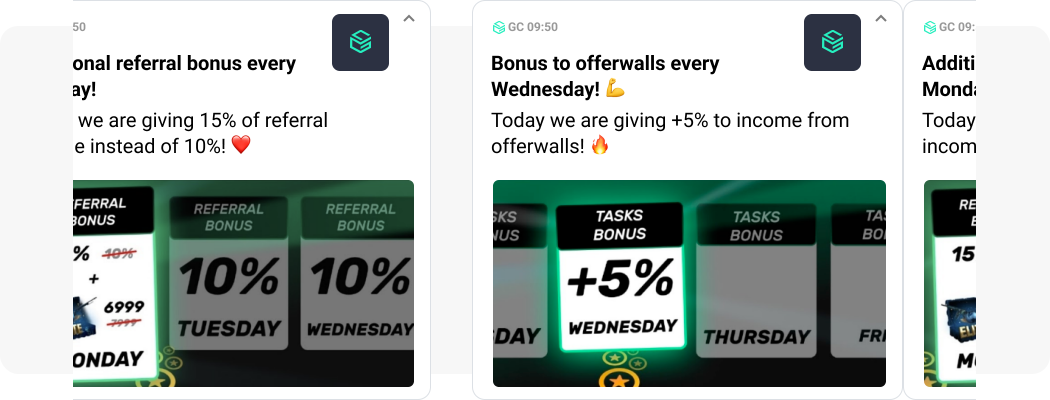
EXTRA TIP: Incorporate daily offers. By doing so, Bladestorm, the publisher of the popular GC.SKINS app and a Pushwoosh customer, boosted their MAU by 16.62% in eight months and even increased their revenue! Learn more in the success story.
- Do a cross-promo
If your company has several games that are similar to one another, you can increase MAU by promoting other games in your portfolio or even rewarding users for engaging with your other games. An example of this could be a message like: “Like playing [this type of game]? Check out [a new game].” or “Enjoying [this type of game]? Then you will love [a new game].
🎲Build a comprehensive messaging strategy for your game app — get ideas from the research-based guide by Pushwoosh
Media streaming apps
- Recommend more content to consume
You can use push notifications to suggest additional content based on a viewer’s/listener’s preferences. For example, if a user just finished watching their favorite TV drama and they don’t have any more episodes to watch, send them a push notification with a suggestion for another show in the same genre.
Or, like Spotify, suggest they listen to their favorite performers on repeat:

Deep Linking is a must-use in push notifications with personalized content recommendations. And you can use it in Pushwoosh!
A simple “You may also like…” message is powerful because it shows users that you’re aware of their interests and gives them an easy way to discover new content.
E-Commerce
Even though MAU certainly shouldn’t be a top-priority metric for e-commerce apps, it’s still worth monitoring and growing monthly active users. By doing so, you can keep your audience engaged and have a chance to promote relevant offers that could lead to more sales or signups.
- Increase current customers’ activity
You can get your least active customers back to shopping by sending them push notifications with new promotions.

For maximum effectiveness, add a product recommendation to your message and target it based on the shopper’s previous purchase history.

EXTRA TIP: Event-triggered messaging can stimulate real purchases! Target users who left any items in their carts and encourage them to complete the order. Read more tips for boosting your e-commerce sales.
- Attract shoppers from the web to your mobile app
To increase your user base and subsequently boost MAU, you can also move users from web to mobile for a more holistic experience. People now more than ever are using their phones for everything they do, with recent studies showing that the average person spends between 4h25min and 10h46min daily on their mobile device. Mobile apps can offer users a much more reliable and personalized experience, allowing them to easily browse and shop with convenience and speed, even on the go. Ultimately, maintaining a great user experience is key to increasing your MAU and growing your user base. So make sure to incorporate special offers and features your customers can only access via your mobile app, for example:
 🌟Pushwoosh customers from the e-commerce category do a tremendous job in engaging their users! For example, Bantoa has an amazing 94% MAU rate. Learn how the brand has achieved it.
Increase active users with on-point messaging
There is no magic algorithm that MAU will help you discover to improve your app’s success. However, by measuring and interpreting your MAU correctly while simultaneously implementing appropriate MAU growth strategies for your industry, you can better understand your app’s health and boost its success through your marketing efforts. Your success will ultimately depend on how you harness the power of your data to create compelling and enaging interactions that drive user acquisition and retention.
If you aim to increase MAU, Pushwoosh has the best marketing communication solutions for an automated experience like no other. Get in touch with our team today.